

Table of Contents
ToggleIntroduction to PPC and content marketing
As the famous philosopher Jerry Seinfeld once said about pain medication, “Fast-acting… or long-lasting? When do I want to feel better? Now? or Later?”
When it comes to online marketing, deciding between investing in the future with long-game strategies such as content marketing or quickly getting runs on the board with PPC campaigns is one of the most challenging calls you need to make, especially when you are just starting.
Of course, where you decide to put your marketing dollars depends on your current situation… How much do you need the sales right now? How’s your cash flow? Are you trying to build a long-term business focusing on search engine traffic, or do you need runs on the board immediately?
There’s no rule saying you can’t do both, and often combining content marketing with paid ads can be a valuable digital marketing strategy. Many marketers use a variety of digital marketing strategies together to get the best results.
We’ll get to that. But first, let’s make sure you actually understand what each one is, how they work, and what kind of return you can realistically expect.
TL;DR (Too Long; Didn’t Read) 👇
- PPC is the fast lane, whereas content marketing is the long road trip. One gets you traffic quickly, the other keeps bringing people through the door long after the ads stop running.
- Google cares far less about word count than it used to. A genuinely helpful 900-word article will beat a bloated 2,000-word snoozefest every day of the week.
- Great content builds trust before a customer even speaks to you. If your articles answer real questions and sound like they were written by actual humans, you’re already ahead of most of the internet.
- The sweet spot is usually both strategies. PPC brings the heat now, while content marketing quietly builds a long-term traffic machine in the background.
Content Marketing - The long game
What is content marketing? It sure sounds fancy.
Content marketing is the internet’s nickname for “write stuff and post it on your website” to get more visitors from search to your blog post and, hopefully, convert them into sales for your business. But, of course, ensuring you write the correct ‘stuff’ is critical to your articles attracting visitors and keeping their attention. A generic article nobody reads doesn’t help anyone.

What is content marketing?
When developing valuable content for your blog, here are some helpful questions you can ask yourself to make sure you are keeping your content on track.
Is the blog post engaging? Does it keep a reader reading?
Am I delivering relevant content?
Am I providing valuable insight or helping the reader?
Does this appeal to the intended audience?
Is this content 'actionable' and inspire readers to act?
Is this the appropriate length to give enough detail on the topic but short enough to be compelling?
What should I write about?
Why are they here?
What are they looking for?
What information do they need to know?
How can I help them decide to become a customer?
That last one is often severely overlooked when writing content for your website, but it’s essential if you want your content strategy to work. Making sure your article answers the reader’s question and presents your products or services as a ‘solution’ is the secret sauce to creating customers from content marketing.
If you’re not sure where to begin, we’ve put together a step-by-step guide on how to create a content marketing strategy that walks you through the whole process.
How much should I write?
There’s a lot of conflicting information in the wild about how long your article should be, and there’s also plenty of conjecture from search marketers about how Google sees page length.
A few years ago, the old advice was more of a hard number, somewhere between 1,200 and 1,700 words. But nowadays, the word count is less relevant than it used to be.
The March 2024 Core Update, along with ongoing crackdowns on scaled, low-value content, all point in the same direction: the need for helpful, reliable, people-first content.
The silver lining is that these shifts actually work in favour of businesses investing in genuine, experience-led content. AI-generated articles have flooded search results, and Google has responded by doubling down on rewarding real expertise and original insight. If your content reflects actual experience, your team’s knowledge, your client results, and your industry perspective, it’s more valuable in Google’s eyes than ever before.
So in basic terms, a focused 900-word article that answers a question thoroughly and shows you’re an expert will outperform a padded, generic 2,000-word piece every time. Write as much as the topic needs. No more, no less.

Why does content marketing work so well?
A reader looking for answers or advice on a topic is at a crucial time in the buying cycle. They are often in the ‘research phase’ and seeking guidance from somebody who knows more than they do.
When done correctly, content marketing is terrific at building authority with your readers, helping them establish trust with you.
A traditional content strategy is a long-term plan; however, depending on the level of research and how targeted your content is, you can gain some traction and generate traffic quickly. For example, if your article is well-written (suitable for the target keyword) and offers a lot of value to your readers, you may find it gets a lot of incoming links and promotions on other sites as well.
We wrote a case study on UAV Training, one of our clients whose content marketing campaign brought in an additional 700 visitors per month.
What are the benefits of a well-executed content marketing strategy?
Long-term traffic for free.
Although writing, producing and ranking blog articles can take a lot of front-loading of time, expense and effort, the payoff can be extremely practical long term.
Visitors now have another entryway into your website as your article gets indexed and ranked in the search engines. Best of all, if your content is engaging and informative, they will be further along the buying funnel. Posting your relevant and valuable content onto social media advertising will also attract new visitors and it’s like getting an extra shot at your content marketing strategy. It’s an organic traffic one-two!
Helping customers solve problems improves conversions.
According to the 2026 HubSpot State of Marketing Report, blog posts were among the top 5 highest-ROI content formats for marketers. Think about that for a hot minute. That’s wild.
The data clearly shows that the more helpful you can be, the more trust you can build with prospects and the more likely they will buy from you. In addition, a good content strategy can provide guidance that’s missing from a traditional salesperson, helping to answer questions and provide reassurance. So, it makes sense to be there.
Building long-term value
A good base of helpful articles on your website is a great way to build reach in search engines and a library of resources that you can use internally to cut down on customer support time.
Is there a question you get asked ALL the time? Turning it into a blog article and directing customers towards it instead of having to answer it every time will save you time.
Becoming a thought leader in your space
Consistent blogging or publishing of articles on your site will start to have a flow-on effect in the market. As well as attracting new prospects from your search rankings for the topic, having a broad base of written content helps to establish your brand as a ‘thought leader’ in the market. Of course, posting lots of engaging content on the social media platforms will help to garner more followers and is a great way to generate leads for your business. In short, create content, build credibility.
This is a fancy way of saying, ‘people trust what you think,’ and it can be a powerful tool for turning readers into customers.
Build relevancy and authority in Google's eyes
Publishing high-quality content and publishing it often is an excellent way to signal to Google that your website is updated regularly and that you might be an authority in your field. Of course, many other ranking factors are at play here, such as technical SEO, incoming links, and relevance, but having a high-quality content marketing strategy is an excellent starting point.
This is a fancy way of saying, ‘people trust what you think,’ and it can be a powerful tool for turning readers into customers.
Are there any cons of content marketing?
Long-term, investing in a content marketing strategy will almost always pay dividends and is a tried and tested marketing method used by thousands of content marketers worldwide. It really works.
Upfront costs
Good article, wrong audience
Writing for a clearly defined audience is essential to get good results in both the organic search results and your website conversion rates. An article meant for doctors, but in a brand voice that suits your average internet user might not work so well.
It takes time
Content marketing is a long game. If you need leads this week, it isn’t your fastest path. That’s where PPC comes in.
Pay Per Click - Pay your way to the top.
What is pay-per-click advertising all about anyhoo?
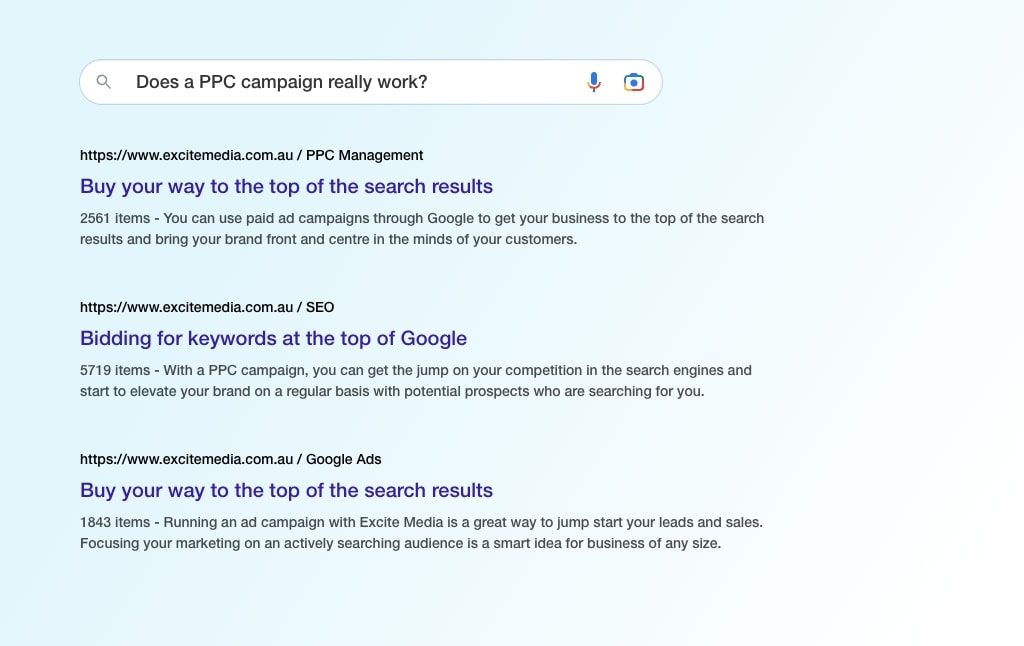
Unlike organic search marketing, where you build up your rankings over time, a PPC campaign through Google, Facebook or another platform lets you reach the top of the search results almost instantly. Getting this kind of immediate visibility is an incredibly powerful tool.
As the name suggests, a pay-per-click campaign is just that. You pay a small fee when a prospect clicks on your ad and visits your website or landing page. Using PPC ads to generate leads is very popular and for a good reason.
We’ve seen it firsthand and consistently. A Google Ads campaign we ran for Pascoe Law, focused on branded terms and high-intent legal services, generated 41 leads and 63 phone calls in just two months, with a 19% conversion rate. Similarly, our PPC campaign for Ultra delivered a 550% return on investment. The numbers speak for themselves when it comes to PPC.
Who determines how much I pay per click?
Because most of these platforms are based on a bid-for-terms setup, the individual per-click bid prices are determined by a few factors.
-
Competition:
How many other businesses are trying to pay for the exact keywords you are? -
Demand:
How much search volume is out there? Is there enough opportunity to start generating leads with pay per click advertising? -
Quality Score:
How well does my ad represent my product or service? A higher quality score can lead to a lower price per click.
Quality score? That sounds ominous and stressful.
Google Ads, the largest PPC platform in the world, determines the quality score of your ads based on a range of factors :
Your CTR ( click-through rate )
How relevant is your keyword to your ad?
What is the quality of the page that users are landing on?
Is the text of my ad relevant?
Improving the quality score of your PPC ads can be a complex undertaking. However, when completed by a trained specialist, it can decrease your per-click cost and therefore the cost of acquiring new customers.

What are the benefits of a PPC strategy?
It's a guaranteed shortcut to results
One of the best parts of a paid advertising approach is that you can see traffic immediately and get traction for your products and services without the usual wait time of an organic SEO campaign. In addition, seeing results more quickly from your PPC advertising allows you to adjust your pricing and product offering much faster.
Jump the line in front of your competition
Turn it up and down
Get results fast to help fund other marketing channels.
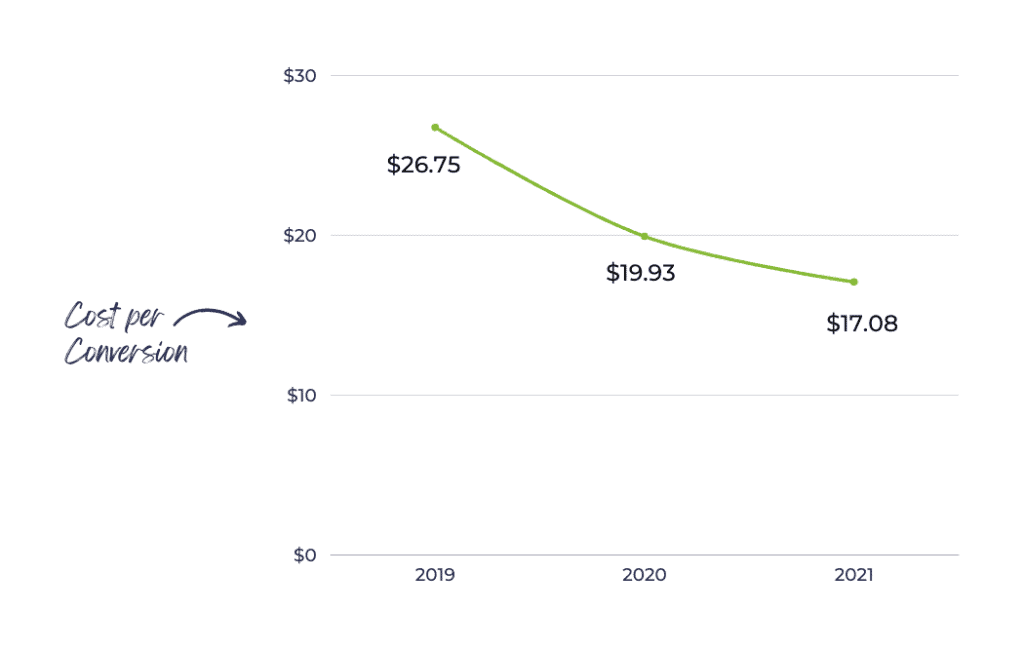
Here’s an example of the results from one of our Google Ads campaigns with Mother Duck. Year on year, their cost per conversion decreased, making the channel more and more affordable for them.
How much does a PPC campaign cost?
Here’s the best part. With a paid marketing campaign through the likes of Google Ads, Facebook or Instagram, you can set a daily budget that you are comfortable with, and you will only ever spend over that amount.
Being able to set your daily limits means you can dip your toe into the PPC world at a pace that suits your business. You can test the waters with different ad copy, imagery etc. and find your way towards good results. Over time, this can start to stack up as you learn the ropes, but it’s certainly possible with a lot of hard work and learning.
How to work out which channel deserves your budget first
This is the question we get asked the most, so we’ve broken it down a little:
If you need leads in the next 90 days
Push your budget toward PPC. Get campaigns live, generate revenue, and use that to fund the longer play.
If you're planning 6+ months ahead
Start your content strategy now. The compounding effect of organic traffic takes time to build, but once it’s there, it’s an asset you own.
If you want the best of both
A 60/40 split is a great starting point for most businesses. 60% is paid to keep leads flowing, 40% is into content to build something lasting.
We’ll almost always recommend a combination of both, because we’ve seen how powerful that approach can be when the channels support each other properly. A great example is Advance Foot Clinic, who initially came to us focused purely on SEO.
Two years later, they’d added Google Ads into the mix, and the results speak for themselves. Organic visitors grew by 1,278% while their Google Ads cost per conversion dropped 17% and conversions increased by 139%. Neither channel did that alone; it was the combination that made it work.
So our advice is to set aside a portion of your budget towards PPC advertising, getting your Google Ads up and running quickly to bring some heat.
Then, work on planning out a content marketing strategy and start building towards a long-term resource of articles on your website that bring in traffic. Bingo!
So, there you have it: the ups and downs, the ins and outs of these effective marketing concepts. While a PPC campaign can get you up and running quickly with leads and sales, it will cost you for every engagement. A content strategy is also an upfront cost. However, it pays off long-term with ongoing traffic flowing with no cost per visit.
Talk to us today about a Google Ads or Content Marketing campaign
Let’s talk about a PPC Strategy to get your business showing up at the top of the rankings, and a Content Strategy to earn ongoing free traffic.